
What this article covers: Three commercial cleaning quotes for the same Perth building can differ by 30–40% and still all be “legitimate.” The gap usually comes down to staffing levels, award compliance, and what’s actually included in scope. This guide walks you through the five things to check on every quote before you sign, the red flags that signal a contractor is cutting corners (and passing the risk to you), a side-by-side comparison template you can use on your own quotes, and what a properly resourced, audited cleaning contract looks like in practice.
If you’ve ever put a cleaning contract out to three quotes and watched the prices come back wildly different, you’re not imagining things. A cheap quote isn’t necessarily a good deal; it’s often a sign the contractor is short-staffing the site, skipping consumables, or misclassifying workers to hit a lower number. When that contract underperforms six months in, the cost of re-tendering, re-cleaning, and tenant complaints usually outweighs whatever you “saved.”
Here’s how to actually compare quotes, like for- like.
Why Cleaning Quotes Vary So Much
Cleaning is a labour-heavy service for most contracts, and wages make up 60–70% of the cost. So when one quote comes in significantly lower than another, the difference is almost always in one of these areas:
- Fewer labour hours than the site actually needs
- Underpaying staff below the Cleaning Services Award (MA000022) minimum rates and penalty rates
- Consumables and equipment are quoted separately or not at all
- No supervision or quality auditing is built into the price
- Casual-only workforce with high turnover and no continuity on-site
None of these show up on the quote’s bottom line; they show up three months later, in missed bins, patchy quality, and cleaners who don’t know the building.

What to Compare on Every Quote
| What to check | Why it matters | Red flag |
|---|---|---|
| Scope of work | Vague scopes (“general cleaning”) hide what’s excluded. | No task list or frequency schedule attached |
| Staffing hours & levels | Determines whether the site is actually resourced to be clean | Hours are far below the industry benchmark for the floor area |
| Award compliance | Underpaid labour is a legal and reputational risk to you as the client, not just the contractor. | Rate implies pay below Cleaning Services Award minimums |
| Consumables & equipment | Often quoted as “extra” to make the base price look lower | The price seems too low for the site size; there is no mention of consumables. |
| WHS & chemical handling | The contractor must manage hazardous substances and safe work practices on your site. | No safety data sheets, no reference to a WHS checklist or induction process |
| Quality control | Someone needs to be checking the work, not just doing it. | No mention of audits, inspections, or a supervisor |
| Contract flexibility | Locked-in multi-year terms with no exit clause are a risk if service drops. | No break clause or performance review period |
The Underpayment Trap (and Why It’s Your Problem Too)
If a quote looks too good to be true, ask how the contractor is paying staff. Cleaning is one of the most underpaid sectors in Australia the Fair Work Ombudsman has run repeated compliance campaigns in the industry, and building owners can be named in supply-chain scrutiny even when the underpayment is technically the contractor’s doing.
This is exactly the problem the Cleaning Accountability Framework (CAF) was set up to solve an independent certification that verifies cleaning contractors are actually paying and treating staff correctly. Ask any shortlisted contractor whether they hold CAF certification or can demonstrate equivalent compliance. If they can’t answer clearly, that’s your answer.
A Simple Way to Compare Three Quotes
Use this as a side-by-side template:
| Criteria | Quote A | Quote B | Quote C |
|---|---|---|---|
| Weekly labour hours quoted | |||
| Award-compliant pay rate confirmed? | |||
| Consumables included? | |||
| Supervision/audit frequency | |||
| WHS documentation provided? | |||
| Contract length & exit terms | |||
| Total monthly cost |
If a contractor won’t fill in every row, they’re not being transparent, and transparency is what you’re actually paying for.
What a Properly Resourced Contract Looks Like
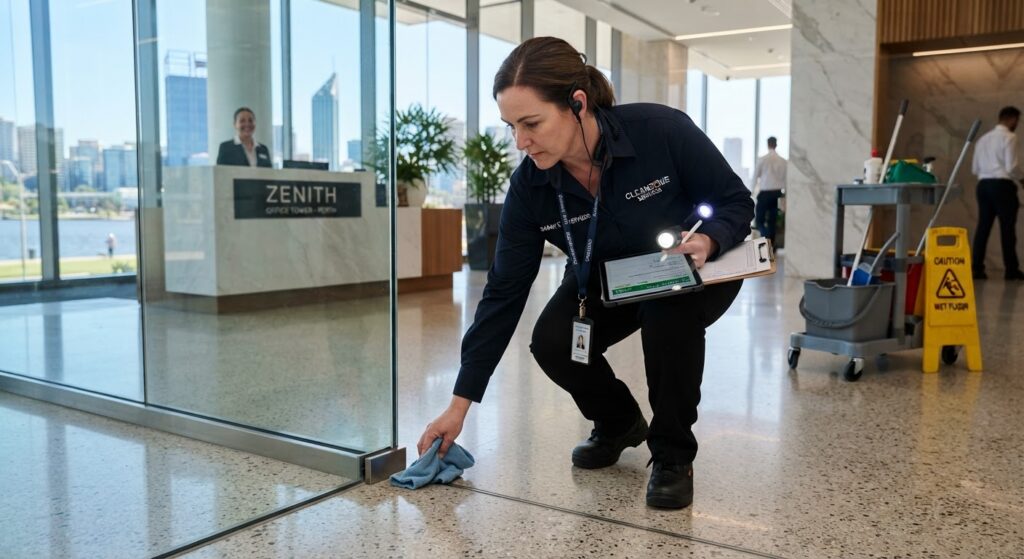
At Cameron Facilities, every cleaning contract begins with a site-specific scope, schedule, and quality checklist, rather than a generic rate card. We conduct regular supervisor inspections to identify issues before tenants report them, and our teams are resourced and rostered to effectively cover the site, whether that’s a CBD office tower, a strata common area, an industrial warehouse, or a mining camp.
This is the same governance approach we bring to our broader building management services, documented systems, real accountability, and a team that answers the phone. You can see how this plays out in practice in our case studies.
Quick Checklist Before You Sign
- The scope of work is itemised, not vague.
- Labour hours match the size and complexity of your site
- The contractor can confirm award-compliant pay rates
- Consumables and equipment are clearly included or itemised.
- WHS and chemical handling documentation are provided.
- A named supervisor conducts scheduled quality audits.
- The contract has a defined review period and an exit clause.
Get a Straight Quote, Not a Guessing Game
If you’re comparing cleaning quotes for a Perth office, strata building, warehouse, or remote site, talk to a team that will show you exactly what’s included and why. Cameron Facilities is triple ISO certified (9001, 45001, 14001), and we’ve been managing cleaning and facilities contracts across WA since 1999.
Call (08) 6154 0910 or schedule a meeting, and we’ll walk your site with you before we quote, not after.
Recent Posts
-
 Perth Building Management: What Wet Season Really Reveals
 -
 Concierge Services for Commercial Buildings: Is It Worth the Investment?
 -
 How to Choose a Mining Camp Management Company in WA (2026 Buyer’s Checklist)
 -
 Commercial Cleaning Services in Perth: How to Compare Quotes Properly
 -
 Concierge Services Perth: What Premium Buildings Should Expect (and Pay)