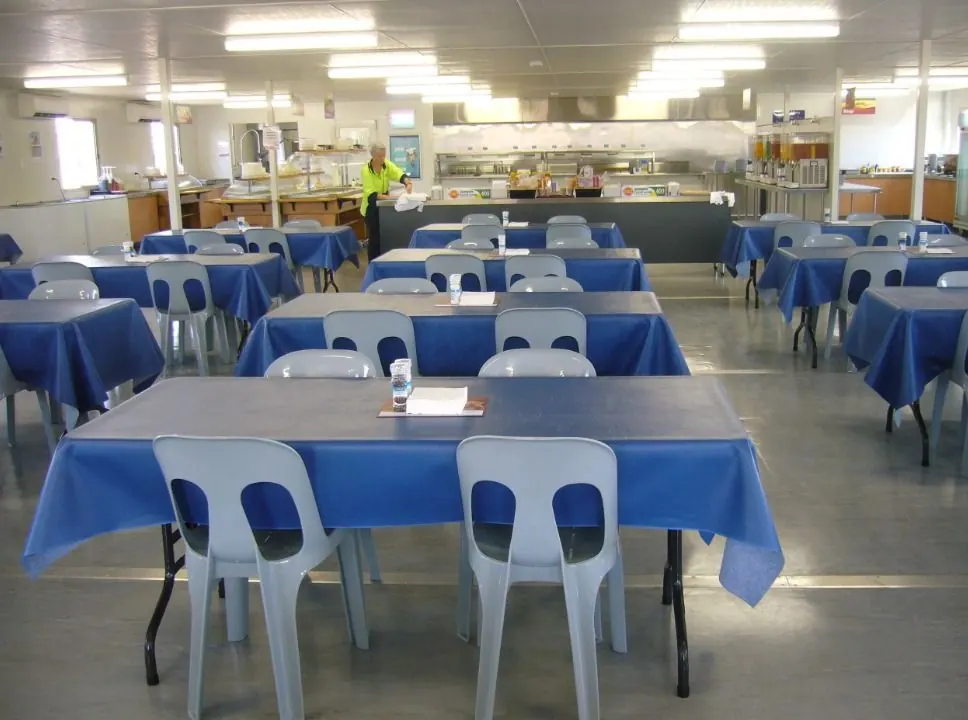
Cameron Facilities is a Perth based mining camp catering company providing catering services across Western Australia, delivering 24/7 meal service designed for the demands of FIFO, DIDO and exploration operations. Mining camp catering has to keep working through shift changes, roster swings and extreme weather, without compromising on food safety or nutrition.
What’s Included in Our Mining Camp Catering Service
- Round the clock meal service aligned to camp rosters and shift patterns
- High energy, nutritionally balanced menus for physically demanding work
- Full mess hall operation, from breakfast through to night shift meals
- Rapid mobilisation for new camps or short term project sites
- Strict hygiene and cold chain management suited to remote conditions
- Ongoing menu variety across long roster cycles
Why Mining Camps Need a Specialist Catering Partner
A mining camp kitchen operates under different pressures to a city catering contract: crews rotate through on fixed rosters, meals need to be available across multiple shift windows rather than a standard lunch service, and resupply can be weeks apart in the more remote parts of the Pilbara and Goldfields. Menu fatigue is a genuine morale issue on long swings, so we plan rotating menu cycles rather than a static set of options repeated week after week. Because camp catering is tied directly to workforce wellbeing on isolated sites, we treat it as an operational priority, not a hospitality add-on.
Why Mining Operators Choose Cameron Facilities for Camp Catering
Mining camp catering is delivered under our ISO 9001:2015 quality management system and HACCP-aligned food safety procedures. It connects with our remote site catering service and our broader mining and remote camp facilities management capability, including mining camp cleaning and camp accommodation management.
How Mining Camp Catering Is Priced
Almost every mining camp catering contract in Western Australia is priced on a per man day basis, meaning a single rate covering all meals provided to one person for one day. That rate normally covers breakfast, a packed crib for the shift, an evening meal, and the tea, coffee and snacks available through the day. What sits outside the rate varies between contractors, and it is where most disputes begin.
Before comparing two catering quotes, establish for each of them whether the following are inside the rate or charged separately:
- Night shift meal service and the second crib for back shift crews
- Freight and resupply to site, which on remote operations can be a significant line on its own
- Kitchen consumables, cleaning chemicals, disposables and crib containers
- Accommodation and flights for the catering crew themselves
- Dry stores, cool room and freezer hire if the camp does not already own them
- Visitor and contractor meals over and above the committed headcount
- Special function catering, site inductions, safety days and community events
Ask also how the rate behaves when occupancy moves. Camp numbers rarely hold steady, and a catering contract with no minimum commitment and no banding will either be repriced when numbers drop or will quietly lose quality instead. A properly structured agreement states the committed occupancy, the bands either side of it, and what happens when actual numbers fall outside them. Our camp cost calculator works through the same arithmetic so you can sanity check a quote before it goes to your board.
Meal Service That Matches the Roster, Not the Clock
City catering runs to a standard service window. A mining camp does not. On a two panel operation there are crews arriving at the mess as others are leaving for shift, and on flight days the whole pattern shifts again. Service has to be built around the roster that is actually being worked, whether that is 8:6, 14:7, 2:1 or an exploration pattern with no fixed swing at all.
In practice that means a hot breakfast available well before the pre start, a crib station stocked and open across the full departure window rather than for a fixed half hour, an evening service long enough to absorb a late bus, and a night crib for back shift that is genuinely equivalent to the day option rather than whatever is left over. Crews notice the difference immediately, and catering is one of the few things on a camp that every single person experiences three times a day.
Food Safety in a Remote Kitchen
Remote catering carries food safety risk that a metropolitan kitchen does not. Resupply is infrequent, the nearest medical support can be hours away, and a food borne illness outbreak in a camp of two hundred people is an operational shutdown as well as a health incident. Cameron Facilities delivers camp catering under a HACCP aligned food safety program and our ISO 9001:2015 certified quality management system.
The controls that matter most on a remote site are the ordinary ones done without exception. Temperature monitoring and recorded cold chain from the point of delivery. Documented receival checks, because a chiller pallet that has travelled two days on a road train cannot be assumed to be sound. Approved supplier lists rather than ad hoc local purchasing. Separation and labelling for allergens, with the allergen matrix available to crews rather than held in the kitchen. Potable water verification where the camp runs on bore or carted supply. Cleaning schedules that are signed off, not assumed.
Food safety standards applicable to remote catering are set out by Food Standards Australia New Zealand, and workplace health and safety obligations for WA mining operations sit under WorkSafe WA, Mining and Exploration.
Dietary Requirements on a FIFO Site
A modern WA workforce is diverse, and the catering has to be as well. Halal, vegetarian, vegan, gluten free, dairy free, diabetic and low sodium options need to be part of the daily cycle rather than something produced on request, because a worker who has to ask every day eventually stops asking and stops eating properly. The same applies to cultural preferences within the crew and to the visiting contractors and community members who pass through the mess.
Dietary requirements are collected at mobilisation and updated as the workforce changes, and the kitchen team is briefed on them rather than relying on a list pinned to a wall.
Resupply and Cold Chain to the Pilbara and Goldfields
The further a camp sits from Perth, the more catering becomes a logistics exercise. Delivery cycles can be weekly or longer, wet season road closures can extend that without warning, and a missed pallet is not recoverable by a trip to the shops. Planning covers frozen, chilled and dry stores separately, holds contingency stock sized to the realistic worst case for that location, and plans menus around what will still be at its best at the end of a resupply cycle rather than only at the start of one.
Menu Fatigue and Why It Affects Retention
On a long swing, the single most common complaint about camp life is the food, and usually it is not quality that is the problem but repetition. A menu that runs on a short cycle becomes predictable inside one roster. We plan rotating cycles long enough that a worker does not see the same evening meal twice in a swing, build in theme nights and seasonal changes, and collect feedback from the crews themselves rather than from the client only. Catering is one of the cheapest levers available for retention on a remote site, and one of the most reliably underused.
What to Ask a Mining Camp Catering Company Before You Sign
- What exactly is inside the per man day rate, and what is charged on top?
- How does the rate change if occupancy rises or falls, and what is the minimum commitment?
- What is your food safety program, and can you show recent temperature and cleaning records from a live site?
- How long is your menu cycle, and how do you handle dietary and cultural requirements?
- Who covers planned and unplanned absence in your kitchen crew, and at whose cost?
- How quickly can you mobilise, and what does mobilisation include?
- What happens to service during a wet season road closure or a missed resupply?
- How do you report, and what will we actually see each month?
- What insurances do you carry, and does your policy include products liability?
- What is your notice period to us, and is it matched to the notice we give you?
Mobilisation
Camp catering is often needed at short notice, either because a project has been brought forward or because an incumbent contractor has failed. Mobilisation covers workforce sourcing and clearances, kitchen and cool room readiness, supplier and freight setup, the food safety program for that specific site, dietary data capture, and the first menu cycle. It connects directly with our camp mobilisation and demobilisation service so that catering, cleaning and accommodation stand up together rather than in sequence.
A Perth Based Mining Camp Catering Company for WA Sites
Our catering work is run from our office at 396 Walcott Street, Mount Lawley, so procurement, supplier contracts, freight planning and senior oversight sit in Perth, close to the wholesalers and freight operators that supply regional camps. We cater for camps across the Pilbara, the Goldfields and Esperance region, the Mid West and the Kimberley, as a single catering contract or as part of our integrated mining camp services. If you are comparing providers, our guide to mine site catering companies in Western Australia sets out what to check, and the camp cost calculator tests a per man day quote.
Mining Camp Catering FAQs
What does a mining camp catering company do?
It runs the kitchen and mess for a remote workforce: breakfast before pre start, crib for the shift, the evening meal and night shift crib, planned around the roster being worked. It also covers menu cycles, dietary requirements, food safety records, resupply and cold chain, and the kitchen crew itself.
How is mining camp catering priced in Western Australia?
Almost every WA camp catering contract is priced per man day, one rate covering all meals for one person for one day. Check what sits outside the rate, such as freight, consumables, night shift service and visitor meals, and how the rate moves when occupancy rises or falls.
Where in Western Australia do you provide mining camp catering?
We work across Western Australia including the Pilbara, the Goldfields and Esperance region, the Mid West and the Kimberley, with procurement, logistics and senior oversight run from our Perth office in Mount Lawley.
Can you cater for halal, vegetarian, gluten free and other dietary needs?
Yes. Halal, vegetarian, vegan, gluten free, dairy free, diabetic and low sodium options are built into the daily menu cycle rather than produced on request. Requirements are collected at mobilisation and updated as the workforce changes.
Can we engage you for catering only?
Yes. We can take catering as a single function, or deliver it as part of an integrated camp contract with housekeeping, maintenance and accommodation management.
How do you manage food safety in a remote camp kitchen?
Catering is delivered under our ISO 9001 certified quality management system and a HACCP aligned food safety program, with recorded temperature and cold chain checks, documented receival checks, approved suppliers, allergen separation and signed off cleaning schedules.
Related Services
- Remote Site Catering Perth
- Food Safety and HACCP Compliance Perth
- Mining and Remote Camp FM
- Mining Camp Cleaning Services Perth
For food safety standards applicable to remote catering, see Food Standards Australia New Zealand, and for workplace health and safety in WA mining operations, see WorkSafe WA, Mining and Exploration.
Request a Quote
If your mining camp needs a reliable catering partner, talk to Cameron Facilities. Request a quote or call (08) 6154 0910.