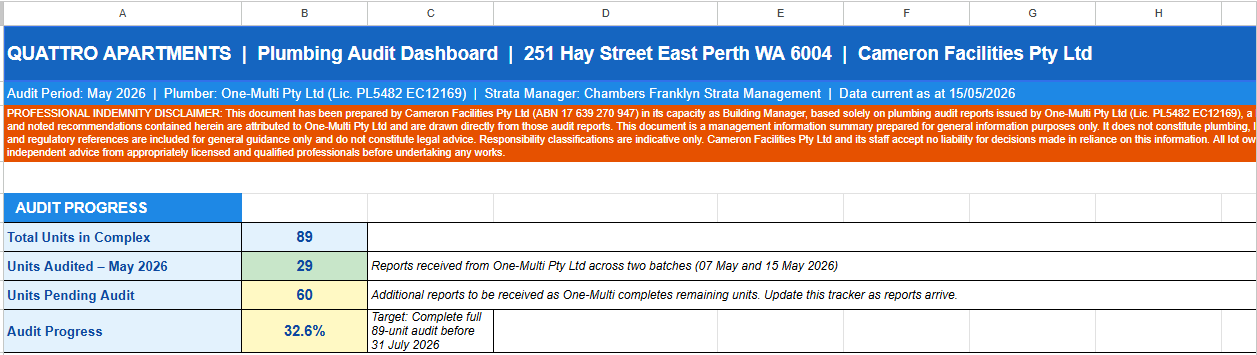
When was the last time your strata building had a proper plumbing audit? For most apartment buildings in Perth, the honest answer is never. That is exactly the gap Cameron Facilities was engaged to close at an 89 unit residential strata complex in Perth, where the Owners Corporation recognised that decades of piecemeal repairs had never been replaced by a structured, building wide picture of the plumbing system. In May 2026, Cameron Facilities completed Stage 1 of that programme, a comprehensive audit covering 29 of the 89 units, producing a 14 sheet defect register, hot water unit analysis, sinking fund assessment, and a 10 year capital expenditure forecast.
This case study explains what the audit covered, what it found, and what it means for any strata building in Perth where the same questions have been quietly accumulating for years.
What a Building Plumbing Audit Reveals
A building plumbing audit is not a once off plumber visit. It is a structured, unit by unit inspection of the entire water system, covering internal pipework, hot water units, isolation valves, drainage, relief valves, wet areas, balconies, and compliance against the current Australian Standards. The results are recorded, ranked by risk, costed, and pulled together into a single document that the Strata Company can act on.
For owners, the value sits in three things at once. First, the audit tells you what is genuinely wrong inside your apartment, often well before a leak forces an emergency. Second, it tells you what the Strata Company is responsible for under the Strata Titles Act 2018 (WA), so the bill lands in the right place. Third, it feeds straight into the 10 year maintenance plan, which is the difference between a building that is funded for the next decade and one that is heading toward a special levy.
Cameron Facilities approached the building as the building manager, not as the plumber. The licensed plumbing contractor on site was One-Multi Pty Ltd. Cameron Facilities engaged them, coordinated access through the strata manager and property managers, received the inspection notes, and turned the raw data into the audit tracker, the council report, and the 10 year capital expenditure forecast that went back to the Council of Owners.
Scope of the Plumbing Audit
Each of the 29 audited units was assessed against the following items:
- Pressure testing and isolation valve operation
- Hot water unit age, condition, and compliance
- Pipework type and condition, including polybutylene and Ipex grey pipe risk
- Drainage and drain flow testing
- Relief valve and safety valve operation
- Shower and wet area condition, including sealant integrity
- Floor waste sealing on undersides
- Balcony condition and water ingress evidence
- Compliance with AS/NZS 3500.4:2018 and the Plumbing Code of Australia 2022
- Tempering valve compliance and outlet temperature recording
Key Findings Across 29 Units
Risk Profile of Audited Units
The audit ranked every inspected unit against a four-tier risk model. The distribution was as follows:
- CRITICAL Risk, 2 units, with active leaks, non-compliant hot water units, and polybutylene pipework failure risk
- HIGH Risk, 12 units, with end-of-life hot water units, non-operational building isolation valves, and active or prior leaks
- MEDIUM Risk, 7 units, with maintenance items and compliance defects requiring attention
- LOW Risk, 8 units, in good overall condition with routine maintenance items only
In plain terms, just under half of the units inspected fell into the HIGH or CRITICAL category. That is a typical finding for a strata complex with no prior audit history, and it is exactly why Cameron Facilities recommends that this type of work be programmed before something forces it.

Hot Water Unit Condition
Hot water units sit at the centre of strata plumbing risk. They are the most common single cause of internal water damage, and replacement is usually the lot owner’s cost, not the Strata Company’s cost. The audit identified the following at the building:
- 6 hot water units requiring urgent or immediate replacement
- 3 units requiring planned replacement within 1 to 3 years
- 2 units with outlet temperatures exceeding 50 degrees Celsius without a tempering valve, which is noncompliant with AS/NZS 3500.4:2018
Because Cameron Facilities was managing the programme across all owners simultaneously, a group purchase opportunity was modelled into the report. Individual replacement was costed at $3,000 plus GST per unit. At a 15 percent group discount across the 10 eligible units, owners would save approximately $4,500 plus GST collectively. At 20 percent, the saving rises to $6,000 plus GST. Most building managers in Perth do not produce this analysis. It only becomes possible when the same party is coordinating across the whole site at once.
Strata Company Obligations Identified
The Strata Titles Act 2018 (WA) draws a clear line between lot owner responsibility, being the internals of each apartment, and Strata Company responsibility, being the building-level common property. The audit identified several items that fall on the Strata Company side of that line:
- 10 building level water isolation valves found to be non operational or only partially operational, meaning water could not be reliably isolated in an emergency across those units
- 1 pressure reducing valve actively leaking and requiring urgent action
- 2 units with confirmed rain related ceiling leaks requiring Strata Work Orders, including one where water was tracking near a downlight, creating an electrical safety concern
Estimated Strata Company works across the 29 audited units sat between $16,200 and $19,200 plus GST, excluding external leak investigation costs.
Understanding the Numbers
Across the 29 units audited, combined estimated lot owner works came in between $87,460 and $91,900 plus GST. Strata Company works added a further $16,200 to $19,200 plus GST. Balcony works responsibility is pending confirmation under the strata plan classification, and that figure will be added once resolved.
These numbers matter because they convert an abstract concept, namely that the building is ageing, into a concrete brief that the Council of Owners can vote on, the strata manager can prepare levy notices for, and individual owners can plan their cash flow around.
Why the Sinking Fund Matters
Under Section 120 of the Strata Titles Act 2018 (WA), every strata company is required to maintain a reserve fund, commonly known as the sinking fund. Under Section 119, a 10 year maintenance plan is also required to underpin that fund. In practice, many buildings in Perth hold one or both of these documents in name only, with little real data behind the numbers.
Cameron Facilities prepared a full 10 year capital expenditure forecast for the building based directly on the audit findings, scaled across all 89 units. The total forecast came in at $1,575,000 plus GST across the next decade, with $574,000 plus GST falling to the Strata Company and $1,001,000 plus GST falling to lot owners.
That kind of evidence based forecast is where the value of proactive building management shows up. A building with a current 10 year plan, supported by real audit data, is positioned to make small contributions over time, rather than facing a sudden special levy when a system fails.

Compliance Issues Identified
The audit also captured several compliance items directly relevant to insurance cover and statutory obligations:
- 2 units with hot water outlet temperatures above 50 degrees Celsius and no tempering valve installed, non compliant with AS/NZS 3500.4:2018
- 1 unit with a bidet installed without backflow protection, which is required under the Plumbing Code of Australia 2022
- 1 unit with a cold water relief valve not plumbed to a drain, non compliant with AS/NZS 3500.4:2018
- 4 units with polybutylene or Ipex grey pipework identified as prone to failure, with the affected owners formally notified of the risk and insurance implications
Where a unit pipework material carries a known failure history, formal notification is not optional. Cameron Facilities ensures the paper trail exists so that risk sits clearly on the building record.
Coordinating Building-Wide Works Efficiently
A riser schedule is the practical mechanism that allows building wide plumbing works to be done without repeatedly turning off the water for residents. By grouping isolation valve replacements by riser, multiple units can be addressed in a single mobilisation, dropping the cost per unit and reducing disruption.
The audit identified 12 risers in the building, several of which contained multiple isolation valve failures that could be coordinated within a single visit. This is the kind of detail that gets missed when works are commissioned reactively, one unit at a time.
Cameron Facilities manages this scheduling using the Stratafy strata and building management platform alongside the SafetyCulture compliance system, the same toolset used across all Cameron Facilities building management contracts.
Is Your Strata Building Overdue for a Plumbing Audit?
Most buildings in Perth have no formal audit history. The cost of finding out, properly, with a structured tracker, a council report, and a 10-year plan, is a fraction of the cost of waiting until a major failure forces the conversation.
Cameron Facilities coordinates the entire process on behalf of the Strata Company and the owners, engaging the licensed plumber, preparing the audit tracker, notifying owners, managing the works register, and preparing the 10 year maintenance plan that goes back to the Council of Owners. Cameron Facilities is a triple ISO certified integrated facilities management business, certified to ISO 9001, ISO 14001, and ISO 45001, operating across commercial offices, strata and building management, grounds maintenance, concierge services, and remote workforce sites in Western Australia and the Northern Territory.
To discuss a plumbing audit programme for your building, contact Cameron Facilities at [email protected]. All quotes carry 14 day payment terms.